Hearing set for sanctions motion in West Virginia foster care lawsuit

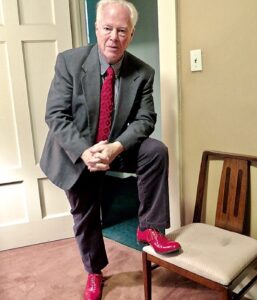
Former DHHR assistant general counsel and Disability Rights West Virginia Legal Director Mike Folio testified before the Joint Committee on Health in 2022 regarding issues with DHHR and transparency. (Photo by Steven Allen Adams)
CHARLESTON — A federal magistrate judge has scheduled a hearing to consider a motion for sanctions against the West Virginia Department of Health and Human Resources over the deletion of emails from top former officials. U.S. Magistrate Judge Cheryl Eifert issued an order Monday scheduling a hearing for 1:30 p.m. Thursday, Jan. 11, at the Sidney L. Christie Federal Building and Courthouse in Huntington on the motion for sanctions against DHHR brought by attorneys representing West Virginia’s foster children in a federal class action lawsuit. Last week, one of the attorneys representing 12 children in the state’s foster system filed a declaration in support of an Oct. 25 motion for sanctions against DHHR. Marcia Robinson Lowry, an attorney and executive director of A Better Childhood, introduced additional testimony and exhibits to back up the request for sanctions. Lowry submitted three exhibits, including testimony from Danielle Cox, the chief security officer for the state Office of Technology, and Michael Folio, the legal director for Disability Rights West Virginia and a former DHHR assistant general counsel. A Better Childhood, Disability Rights West Virginia and attorneys with the Shaffer and Shaffer law firm are seeking sanctions after attorneys for DHHR admitted in an Oct. 6 letter that emails for seven former officials had been deleted by the Office of Technology (OT) — the state’s internet service provider — even after deposition holds were requested by DHHR. Attorneys for DHHR, represented by the Brown and Peisch law firm, have since apologized to both opposing counsel and the court for not preserving the electronically stored information (ESI) despite what they called “reasonable efforts” to do so. The motion for sanctions accuses DHHR of “deliberate indifference” by not ensuring that the three years of emails from top officials – including former DHHR Secretary Bill Crouch and former Commissioner of DHHR’s Bureau for Children and Families Linda Watts – was preserved. The class action lawsuit, filed in 2019, alleges foster children in the state are often housed either in hotels, shelters, institutions or out of state and are subject to abuse and neglect. A transcript of a Nov. 23 deposition of DHHR General Counsel April Robertson indicated that, despite emailing the litigation hold in 2019 to the DHHR officials and the Office of Technology, she did not follow up with OT when she did not receive an acknowledgement or confirmation that they received the hold. According to Robertson’s deposition, the litigation hold email to OT did not include a list of DHHR employees whose emails were to be preserved. And no follow-up was made either by OT or Roberston or other DHHR employees under the litigation hold. OT officials later testified that Robertson’s litigation hold email was “insufficient to preserve email accounts.” According to the Department of Administration, which oversees OT, agencies are required to notify OT of departing state employees by submitting a deprovision form. This form starts a 30-day countdown for agencies to download and preserve any emails or other electronically stored information before OT deletes the former employee’s account and data. Litigation holds are exempt from this policy, which has been in place for at least 10 years. “The testimony of Danielle Cox and the Affidavit of Michael J. Folio support that Defendants were not only aware of (the Office of Technology’s) policies regarding the destruction of data 30 days after the authorization to deprovision an employee account, but that DHHR had been specifically requested to preserve the data of Bill Crouch in other matters immediately following his resignation and failed to do so,” Lowry said. Agencies with litigation holds are required to file those holds with OT’s security team. Emails for Crouch, Watts and three other former DHHR officials were subject to a litigation hold. Attorneys for the foster children also argue that DHHR should have maintained emails for former interim cabinet secretary Jeffrey Coben and Laura Sperry-Barno, a former office director for DHHR’s Office of Children and Adult Services. An affidavit filed by Folio, who served as DHHR assistant general counsel and general counsel for DHHR’s Office of Health Facilities from 2019 to 2022, said he emailed Robertson in his capacity as legal director for Disability Rights West Virginia following the Dec. 12, 2022, announcement that Crouch had resigned. Another letter was sent to Coben on Dec. 20, 2022. “…I sent an email to Ms. April Robertson regarding ‘Electronic Data Preservation’ and demanded that Ms. Robertson in her capacity as DHHR’s chief legal counsel preserve the cell phones and data on the cell phones involving Mr. Crouch and select members of DHHR leadership,” Folio said. “Upon information and belief, Ms. Robertson … failed to take the required action to preserve the cell phones and electronic data involving Mr. Crouch.” Folio was subject to an investigation by the Office of Disciplinary Counsel (ODC) and the Investigative Panel of the Lawyer Disciplinary Board after Crouch and Robertson filed a complaint against Folio last year. That complaint was dismissed earlier this month after investigators found no probable cause. Folio alleges the complaint was made in retaliation for raising concerns about issues at William Sharpe Hospital near Weston. Folio said the issue of whether DHHR officials were aware of OT’s policy of deleting emails and other electronic data for former employees after 30 days was raised. “It is common knowledge that 30 days after state employees separate from a state agency the employee’s emails and other electronic information are routinely destroyed or not preserved unless appropriate action is taken otherwise,” Folio said. “As I have advised the ODC, Ms. Robertson and Mr. Crouch were both aware of this established practice and the deprovisioning of emails,” Folio continued. “I had a discussion of this practice with each … upon learning that a DHHR employee’s email account was deprovisioned and the apparent spoliation of evidence when I served as (Office of Health Facilities’) general counsel.” The state recently agreed to a proposed $4 million settlement regarding conditions at the Southern Regional Jail near Beckley after U.S. Magistrate Judge Omar J. Aboulhosn’s 39-page order finding in favor of a motion from inmates seeking default judgment against the state. Aboulhosn accused DCR officials of intentionally destroying evidence, including emails and electronically stored documents. Gov. Jim Justice and Department of Homeland Security Cabinet Secretary Mark Sorsaia have denied the intentional destruction of electronic records. Brad Douglas, the former interim commissioner of the Division of Corrections and Rehabilitation, and Phil Sword, chief counsel for the Department of Homeland Security were terminated last month. Steven Allen Adams can be reached at sadams@newsandsentinel.comLocal 911±¬ÁϳԹÏ

Law & Order: Frontier’s Payton Tyler prepares for legal career

Amy Elliott named dean of MC’s McDonough Center for Leadership and Business
Sheehan case to block rules limiting candidate statements fails

Washington County Commissioners say they don’t approve data center tax abatement

Willis targets Shelley Moore Capito in GOP Senate primary challenge