Look Back: Going underground
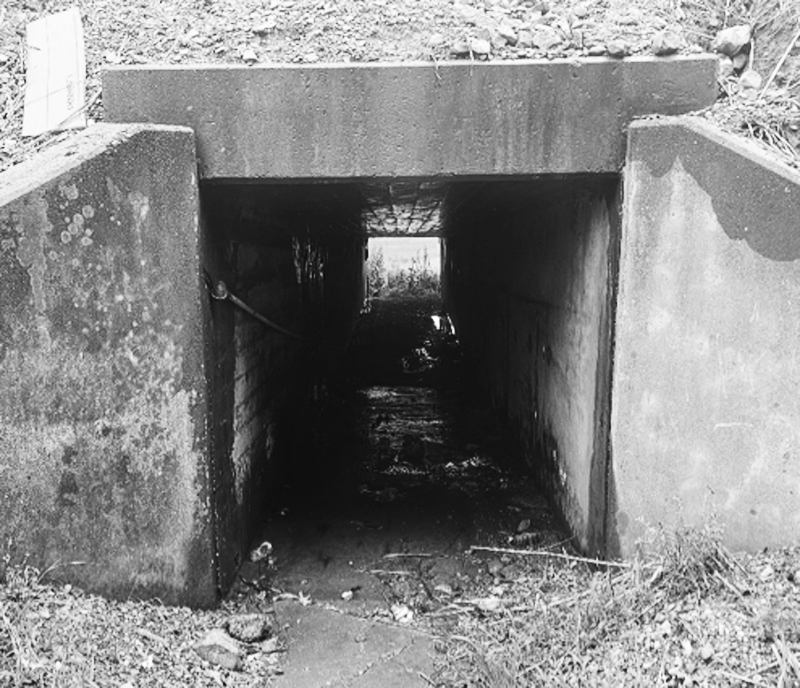
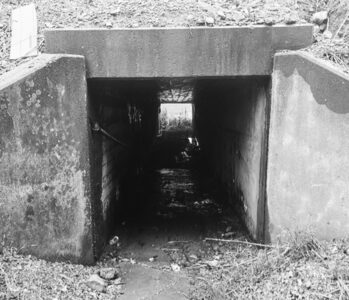
The “tunnel� under DuPont Road at what was the Tebay Dairy allowed cattle to be safely moved from one side of the busy highway to the other side. (Photo provided)
“They say there’s a tunnel…”
Perhaps only the discovery of a treasure map can do more to spark our excitement than the thoughts of a secret tunnel! Whether it be on the bank of a river, in the basement of an old house, or from a Hardy Boys mystery book, the mere thoughts of a “tunnel” can quickly turn our thoughts into a doorway to unknown treasure.
To be accurate, there are “tunnels,” and there are “tunnels,” and there are actual tunnels.
For example, on DuPont Road, there is a “tunnel” at the Bickel mansion, and another a short piece down the same road at the Tebay Dairy farm. However, after speaking with MaryAnn Bickel Gideon in 2005, I was told that the tunnel is actually just an “underpass.” In the 1940s, the level of Rt. #68 was raised from the level of the Bickel racetrack to its current elevation, Wig Bickel wanted a way to safely get his horses from the stable to the racetrack side of the highway. Being a man of influence, the State Road created for him a simple, flat-bottomed “tunnel.” It was for the same reason that the “tunnel” at the Tebay farm was created. The only difference is that it was to safely get cattle from one side of the road to the other.
Another “tunnel” was supposedly built into the home of Dr. Monroe when he built on Park Avenue in 1899. The good doctor, a dentist, became quite wealthy by being the first doctor who could offer pain-free extractions – he was the first to use “laughing gas.”
The very attractive home, currently the residence of Charlotte and Randy Modesitt, has a beautiful fountain in the front. And, there is/was a tunnel. According to Charlotte, the small brick-lined tunnel is/was underground access to the pump-head that supplied water to the fountain. Unfortunately for tunnel-enthusiasts, the basement access has been sealed with brick and mortar.
In Washington Bottoms, a home built by Emil Meldahl in the 1860s also had a tunnel.
Mr. Meldahl was a successful, self-taught wine master. Part of his winery was a unique wine cellar located some distance from the main house. Part of his success in wine making was attributed to the fact that he had created a means of natural air-movement through the winery. This was achieved through the means of a “tunnel,” approximately 18 inches by 30 inches wide that connected the wine cellar to the basement of the house. The tunnel apparently acted as a chimney-flue, causing a draft into the wine cellar, cooling the air as it traveled underground, thus cooling the barrels of wine
True or not, lore shares that this tunnel also had another use. Supposedly, the tunnel was also used by fleeing slaves as a passageway to get from the house to the wine cellar, which then allowed them to scramble the short distance to the Ohio River undetected.
The home built by Mr. Meldahl burned in the 1890s, but another was built on the same foundation by his daughters, Maggie and Lily. This home, still standing, is listed on the National Register of Historic Places.
To be continued…
***
Bob Enoch is president of the Wood County Historical and Preservation Society. If you have comments or questions about Look Back items, please contact him at: roberteenoch@gmail.com, or by mail at WCHPS, PO Box 565, Parkersburg, WV 26102.